"Amateur lighting asks: is the subject bright enough? Cinematographer's lighting asks: where is this light coming from, and does the frame believe it?"
Motivated lighting makes every light feel like it belongs to the world of the scene. The visible source gives the audience an alibi, while the real source may sit off-frame. For prompts, name the source first, then describe the direction, color, and falloff it creates.
Every light needs an alibi.
Motivated lighting means every light in the frame has a believable source inside the world of the scene — a window, a lamp, a phone screen, a fire, a passing car. The audience never thinks about it consciously, but their eye is constantly checking: does this light make sense? When it does, the image feels real. When it doesn't, something reads as off, even if the viewer can't say what.
Here's the part that trips people up. The visible source usually isn't the light doing the real work. A practical lamp bulb isn't bright enough to expose a face on camera, so the cinematographer leaves the lamp in frame as the alibi — the thing that says "light comes from here" — and hides a much stronger film light off-frame, aimed from the same direction, in the same color. The eye believes the lamp. The real exposure comes from a source it never sees.
AI models don't know any of this. Ask for "cinematic lighting" and the model reaches for a flat, even, sourceless wash — bright everywhere, motivated by nothing. That flatness is the single biggest reason AI video reads as fake. The fastest way to fix it is to stop describing how the shot should feel and start describing where the light comes from.
The best way to learn it is to watch how real films handle it — including when they bend the rule on purpose. Three frames, three lessons.
When the motivation is only half-true.
Here's a frame that looks like textbook motivated lighting. A character sits in bed at night, lit by the screen of her laptop, framed by two warm bedside lamps. Three sources you can see, all doing visible work. But study it the way a cinematographer would — and a quiet contradiction shows up.
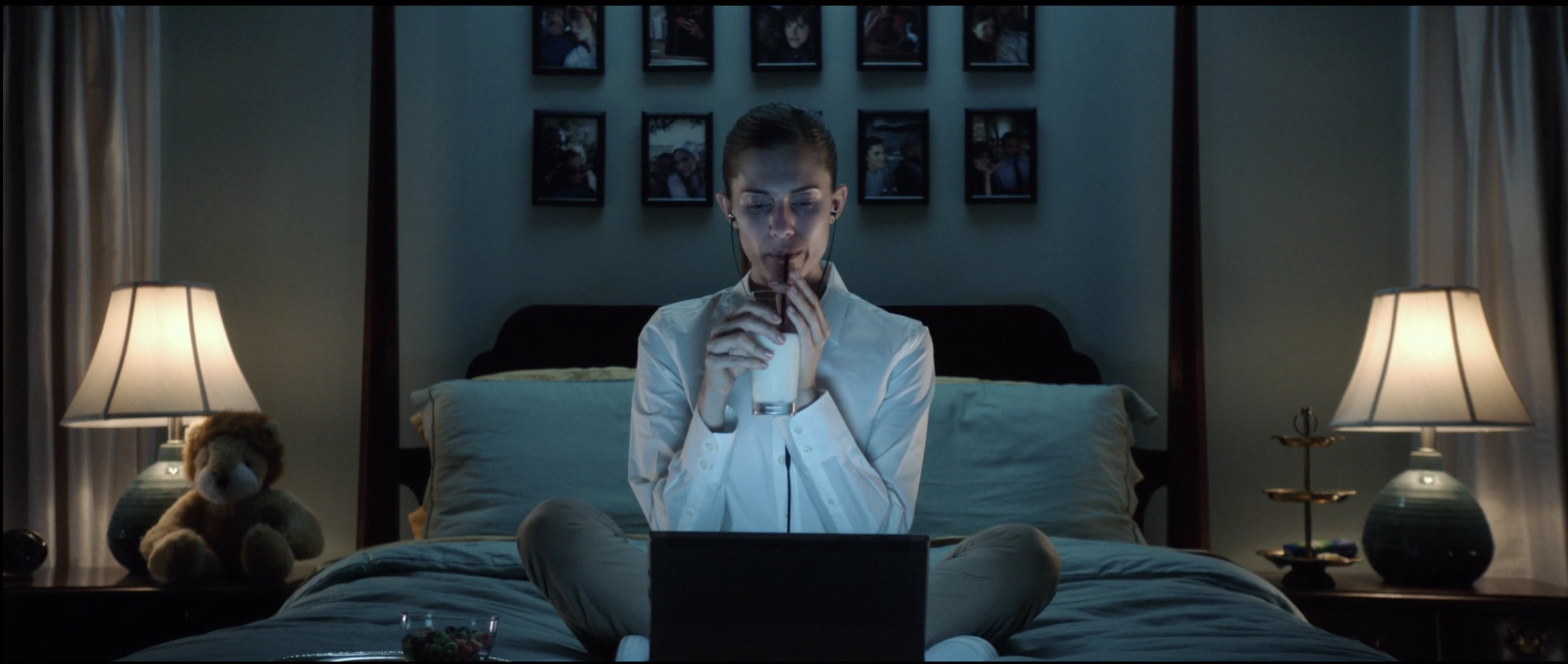
The laptop explains the lower face. The lamps explain the warm edges. But nothing in the frame explains the bright line across the top of her hair — that's a hair light, mounted above and behind, and there's no lamp, no fixture, no window up there to justify it. The picture frames confirm it: their shadows drop straight down, which only happens under a light that's overhead. The shot leans on real sources for most of its look, then quietly adds one that has no alibi at all.
Is it a mistake? Not necessarily. Get Out is a horror film, and a light with no logical source is exactly the kind of thing that registers as faintly wrong before you can say why — which is the feeling the whole scene is built to provoke. But that's a choice made by people who know the rule cold. When an AI render does the same thing by accident, it just reads as fake.
And when it's done perfectly.
Now the opposite — a shot where the motivation holds completely. A packed movie palace, seen from behind the audience. Everyone, the whole room, seems to be lit by a single thing: the film playing on the distant screen. It looks effortless, almost like a documentary grabbed in available light. It was one of the hardest lighting setups in the film.
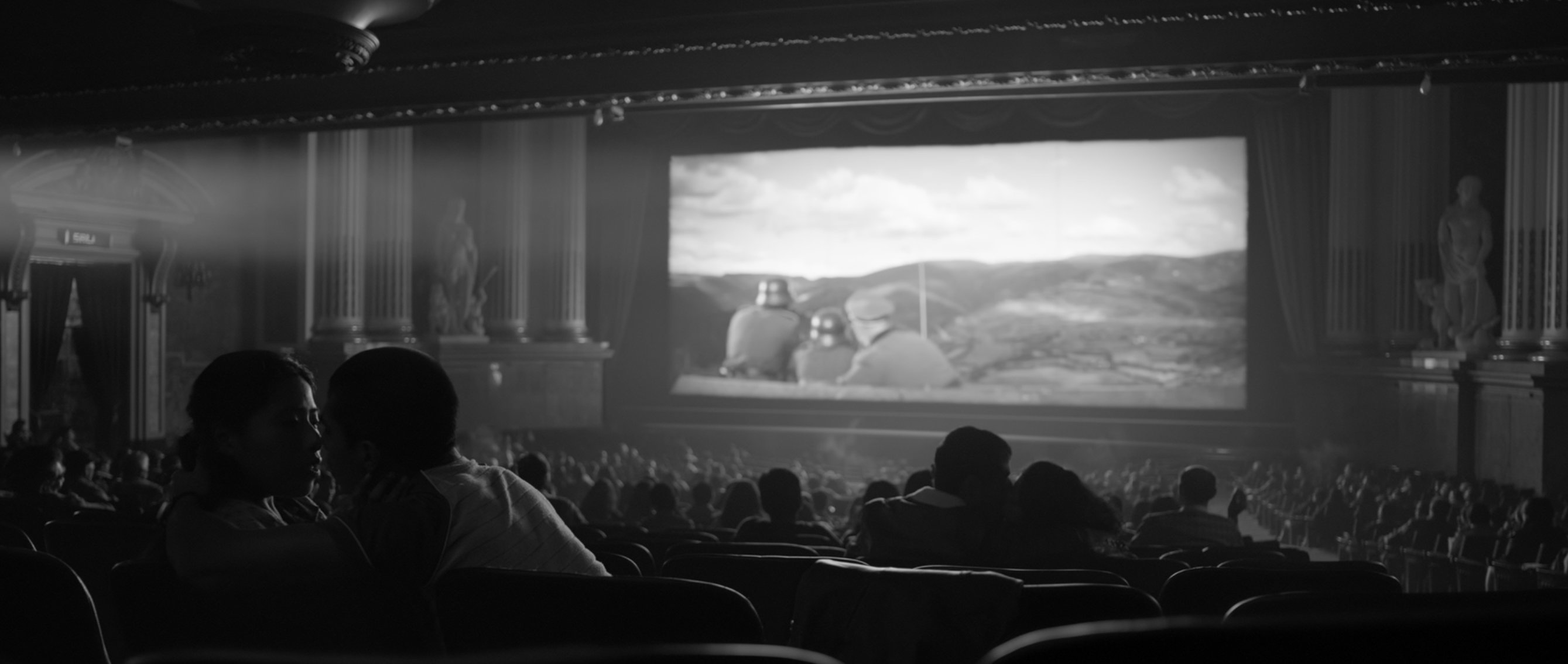
Alfonso Cuarón, who shot the film himself, was firm about it: he didn't want movie lights, he wanted the scene lit by the screen, in sync with the projection. The problem is physics — a real 35mm projection throws almost no usable light onto a room. So the trick was to build the "screen" out of a giant LED wall playing the same film, bright enough to actually light the space, with smaller panels on each side to wrap the glow further around the crowd. All of it was painted out in post and replaced with the real projected image.
Here's the part that matters most: the audience in the foreground needed their own light to read as faces rather than silhouettes — so there was a second, dimmer layer of LED, aimed at the actors, and crucially, also synced to the projection. When the movie on screen flickers bright, the light on the couple flickers with it. The eye never catches the lie because every hidden source obeys the one visible source. That is motivated lighting at its peak: not one light, but many — all pretending to be the screen.
"Looks like one source" almost never means one light. It means every light was matched — direction, color, and timing — to the source you're allowed to see. The craft is in the agreement, not the count.
And the trade-off every shot makes.
Most real shots live between those two poles. Here's one that motivates its color perfectly — and then quietly breaks the rule in one specific place, for a reason every filmmaker will recognize.
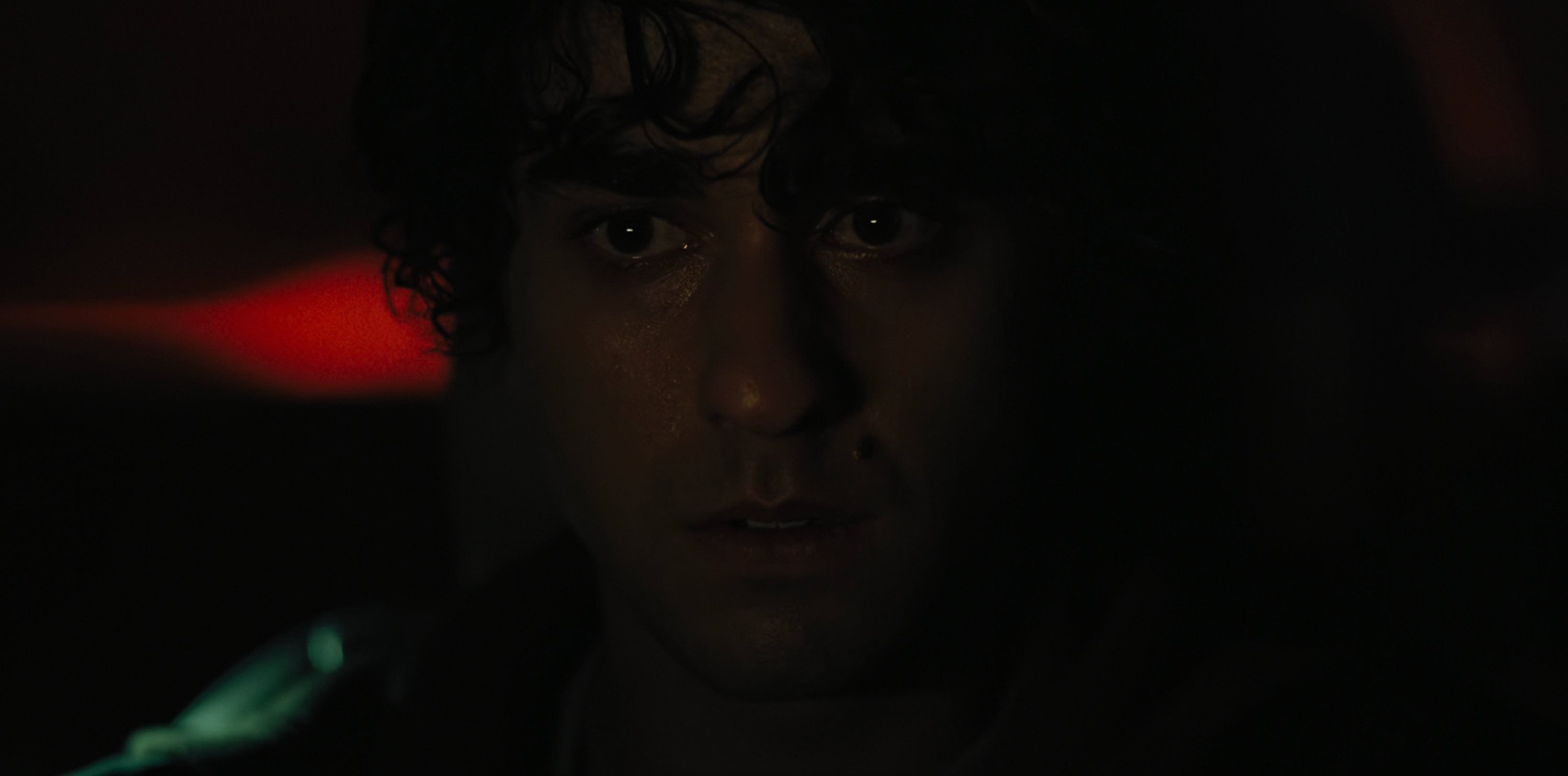
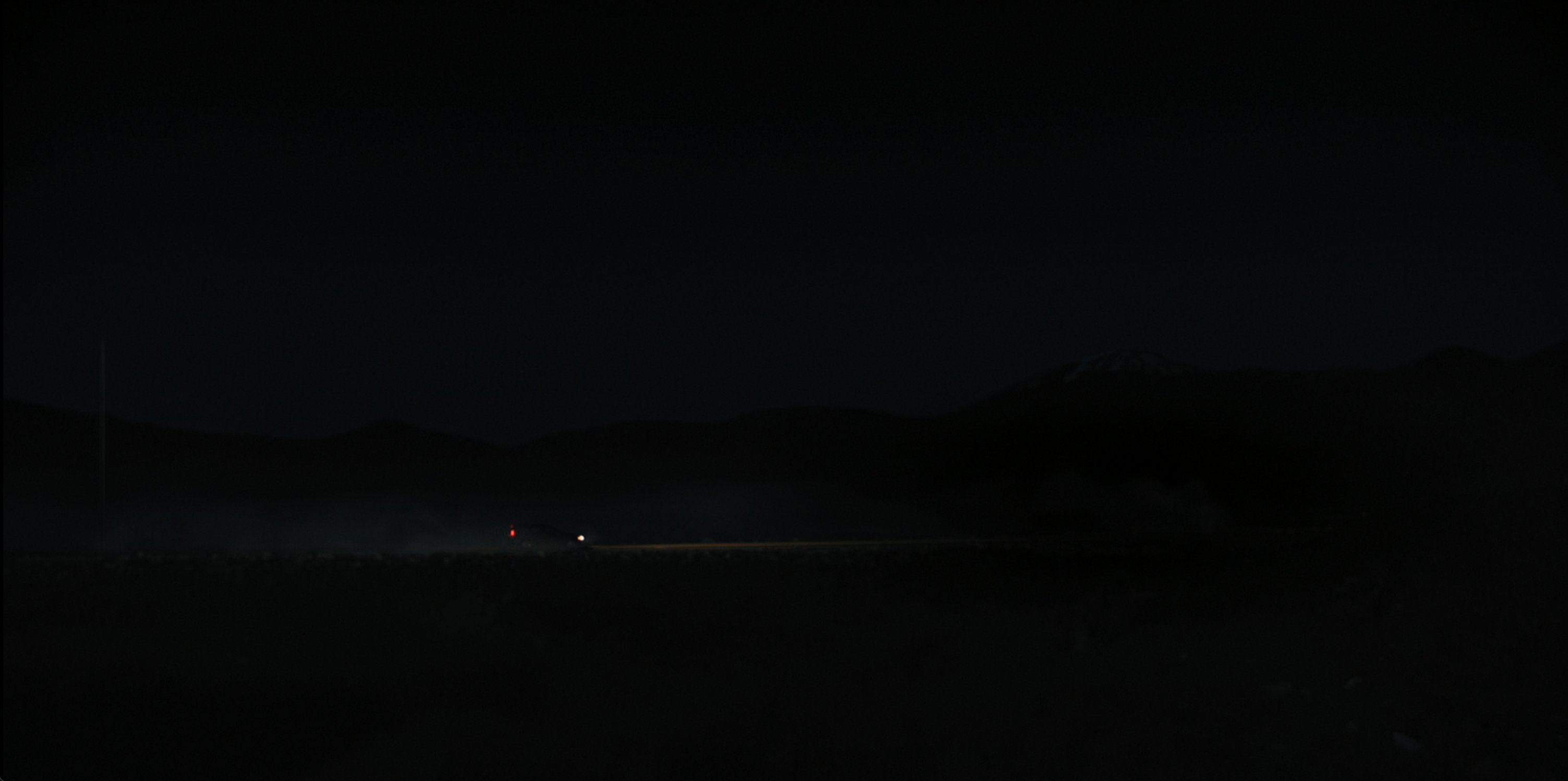
The color is doing its job. A warm red wash from one side, a cool green spill from below — your eye files them as "car at night" before you even think about it, because those are exactly the colors a dashboard and tail-lights produce. That part of the motivation is airtight. So why the white rim on his shoulder? Because without it, his shoulder and the entire right side of his body would vanish into a black background — he'd be a floating face. The cinematographer added a clean edge of light to hold him out from the dark. There's no source for it in the world of the scene; it exists purely to keep the figure readable. Pawel Pogorzelski, who shot the film, has been open that horror let him push toward harder, more expressive lighting than strict realism would allow — and this is exactly that: a small, deliberate lie in service of the image.
This is the trade-off every lit frame negotiates — perfect motivation versus a subject you can actually see. The skilled version keeps the unmotivated light small, soft, and plausible enough that you don't consciously catch it. The amateur version — and most AI renders — either lets the subject disappear into the dark, or slaps on a separation light so bright and sourceless that the whole frame stops feeling real.
If your AI subject keeps dissolving into a dark background, don't just ask for "rim light." Give the rim a reason: a streetlight behind them, a window, a neon sign, the moon. A motivated edge separates and stays believable. A sourceless one separates and looks fake.
From analysis to prompt.
You can't place lights in an AI prompt — but you can describe the conditions that imply them. The move is always the same: name the source the viewer should see, then name the direction and color the light actually comes from, so the model builds a frame that agrees with its own logic. Stop writing the mood; write the cause of the mood.
The second prompt never says "moody" or "cinematic." It doesn't need to — the mood is the byproduct of one motivated source doing its job. The fridge is the alibi; the direction and color and falloff are the instructions that make the light obey it.
Same rim light either way — but the second one comes from somewhere. That's the whole difference between an edge that reads as cinematic and one that reads as a sticker.
The Core Ideas
- AI video looks fake because the light has no source. "Cinematic lighting" gives you a flat, even, motivated-by-nothing wash.
- Motivated lighting gives every light an alibi. A source in frame the eye can point to and believe.
- The visible source isn't the real light. The lamp is the alibi; a stronger hidden light, aimed from the same direction, does the work.
- "One source" is usually many. Roma's theater was a wall of LEDs synced to the screen — every hidden light obeying the one you see.
- Separation fights motivation. A rim that keeps a subject out of the dark often has no real source — keep it small, soft, and plausible.
- Describe the cause, not the mood. Name the source, direction, and color. Let "dramatic" be the result, never the instruction.
Try it on your
own frame.
Upload a still, study the lighting, camera, color, and tone, then turn that reading into a prompt you actually understand.
Study a Frame